

THE DIFFERENCE BETWEEN MESSAGING AND NARRATIVE
Most organizations spend significant time refining messaging.
They workshop positioning statements.
Test headlines.
Adjust launch language.
Refine campaign copy.
But even after extensive communication work, some products still feel difficult to explain.
Not because the messaging is weak.
Because messaging and narrative are not the same thing.
Messaging explains a product.
Narrative shapes how the product is understood.
That distinction matters more than many teams realize.
Messaging Operates at the Surface
Messaging is typically designed to communicate clearly and efficiently.
It answers questions like:
What does the product do?
Who is it for?
Why should someone care?
How is it different?
This work is important.
Clear messaging improves:
comprehension
consistency
market communication
adoption
But messaging usually operates downstream from deeper strategic decisions.
It communicates meaning that has already been shaped elsewhere.
That is why strong messaging alone does not always create clarity.
Sometimes it simply explains an unclear structure more effectively.
Narrative Operates Structurally
Narrative works differently.
Narrative is not just storytelling.
It is the structure through which a product becomes interpretable.
It shapes:
what the product represents
which signals matter most
how decisions connect
how the market contextualizes the product
Narrative influences meaning long before communication begins.
This is why two products with similar functionality can feel completely different in the market.
The distinction often comes from:
structure
emphasis
interpretation
coherence
Not messaging quality alone.
Product Meaning Forms Earlier Than Most Teams Think
A common assumption is that meaning is established during launch.
But products begin signaling meaning much earlier.
Every decision communicates something:
which customer matters first
which problem deserves focus
which tradeoffs are acceptable
what role the product intends to play
Over time, those signals begin forming a narrative structure.
Even when no formal narrative exists.
This is one reason many organizations eventually experience:
positioning drift
fragmented messaging
inconsistent market understanding
expanding feature logic
The issue is often not communication capability.
It is structural coherence.
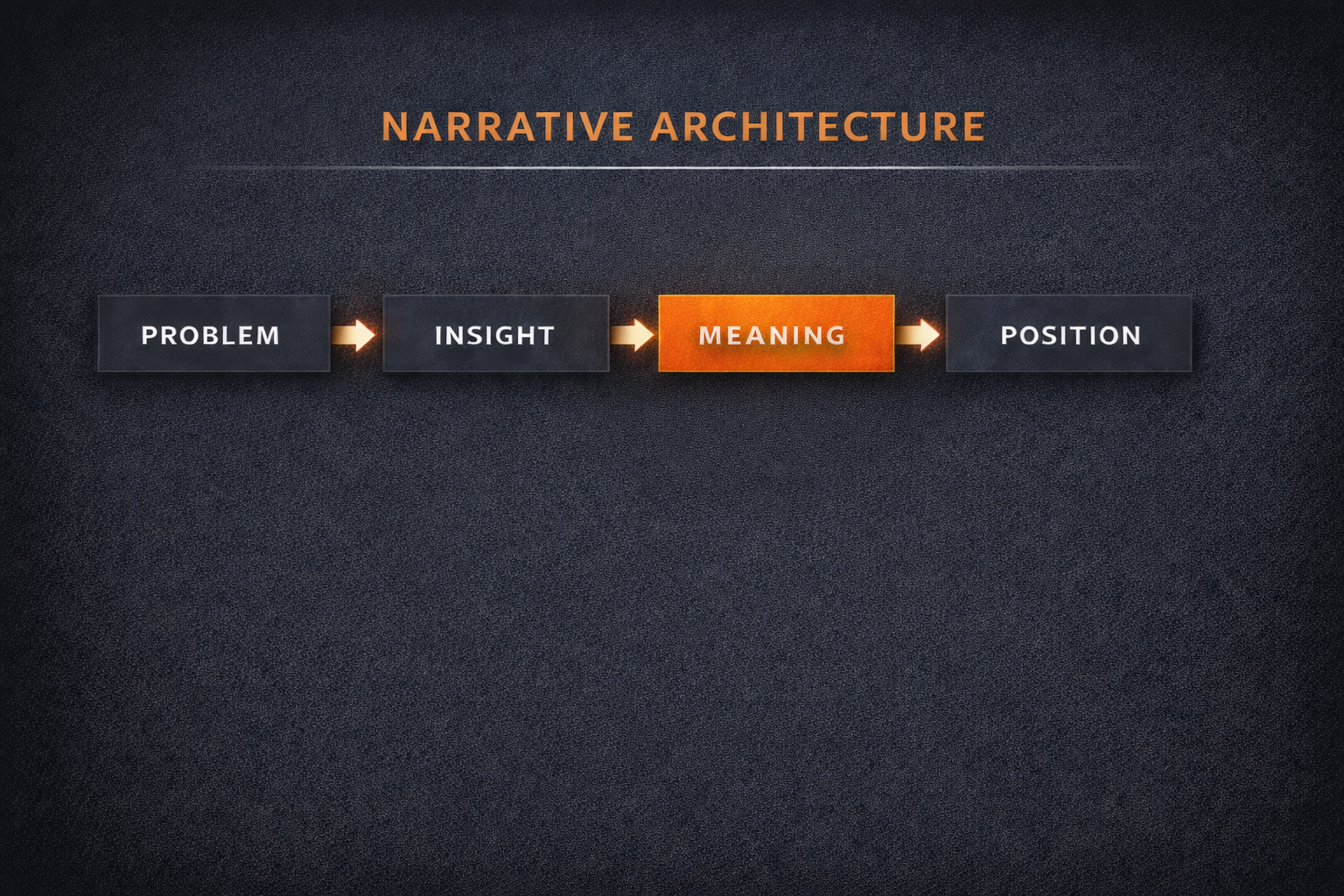
Product Narrative Architecture
Narrative does not emerge from messaging alone.
It develops through a deeper structure of:
problem
insight
meaning
and position
What products ultimately represent in the market is shaped long before communication begins.
Why Messaging Alone Eventually Breaks Down
When organizations rely too heavily on messaging to create clarity, communication often becomes increasingly reactive.
If the market misunderstands the product:
rewrite the messaging.
If positioning weakens:
adjust the campaign.
If differentiation declines:
refine the language again.
Sometimes these changes help temporarily.
But messaging can only work within the structure already established by the product itself.
If the underlying narrative lacks coherence, communication eventually reaches its limits.
This is why some products require constant explanation while others feel naturally understandable.
The difference is rarely copy alone.
It is usually the underlying narrative architecture shaping interpretation beneath the surface.
Narrative Shapes Strategic Direction
One reason narrative is frequently misunderstood is because it gets reduced to communication.
But narrative also influences:
product prioritization
category positioning
interpretation
market expectations
internal alignment
It helps determine:
which ideas feel consistent
which features reinforce meaning
and which decisions create fragmentation
This is why narrative cannot simply be “added later.”
By the time messaging begins, the product may already be signaling a meaning that is difficult to reshape.
Explanation and Meaning Are Different
A product can be clearly explained and still lack clear meaning.
That distinction is critical.
Explanation answers:
What is this?
Narrative answers:
Why does this matter?
What role does this product play?
How should it be understood?
Many organizations unintentionally optimize for explanation while neglecting interpretation.
But markets do not respond to functionality alone.
They respond to meaning.
And meaning develops structurally over time.
Why This Matters More Now
As markets become increasingly saturated, functional advantages tend to narrow faster.
Many products can now deliver similar capabilities.
What becomes more difficult is establishing a coherent market meaning.
The products that stand out are often not the ones communicating the loudest.
They are the ones where:
product
positioning
narrative
and market interpretation
reinforce one another consistently.
That kind of coherence rarely happens accidentally.
It is usually the result of narrative entering earlier in the strategic process.
Closing Thought
Messaging explains a product.
Narrative shapes how the product becomes understood.
One communicates.
The other structures meaning.
And in increasingly crowded markets, that distinction may matter more than ever.