

THE ARCHITECTURE OF PRODUCT MEANING
Many products struggle with clarity, not because they lack functionality, but because meaning was never intentionally designed.
Organizations frequently assume meaning emerges after launch.
Build the product.
Refine the messaging.
Launch the campaign.
The incorrect expectation is that the market will connect the dots.
Markets do not interpret products through communication alone. They interpret products through the decisions embedded within them. Long before customers encounter an advertising campaign, they begin forming impressions about what the product is, who it serves, and why it deserves attention.
That is why two products with similar capabilities can occupy very different positions in the market. One feels immediately understandable. The other requires constant explanation.
The difference is not functionality. but the architecture of meaning beneath the product.
Products Do Not Communicate Through Features
Features do not speak for themselves.
A feature explains what a product does. It does not explain why the product matters. The market fills that gap by interpreting the product within a broader context.
Customers naturally ask:
What role does this product play?
Which problem is it solving?
Why does it exist?
How should it be understood?
Those questions shape interpretation. Features provide capability. Interpretation provides significance.
That is why two products with similar functionality can occupy very different positions in the market. Their capabilities may be comparable, but the interpretation surrounding those capabilities is not.
Without a coherent interpretation, products begin accumulating:
expanding feature sets
fragmented positioning
inconsistent messaging
unclear differentiation
The product continues to evolve, but its meaning does not.
Meaning Develops Through Layers
Product meaning develops in layers.
It begins with a problem worth solving. Insight reframes the problem. Meaning shapes positioning. Positioning becomes the story the market remembers.
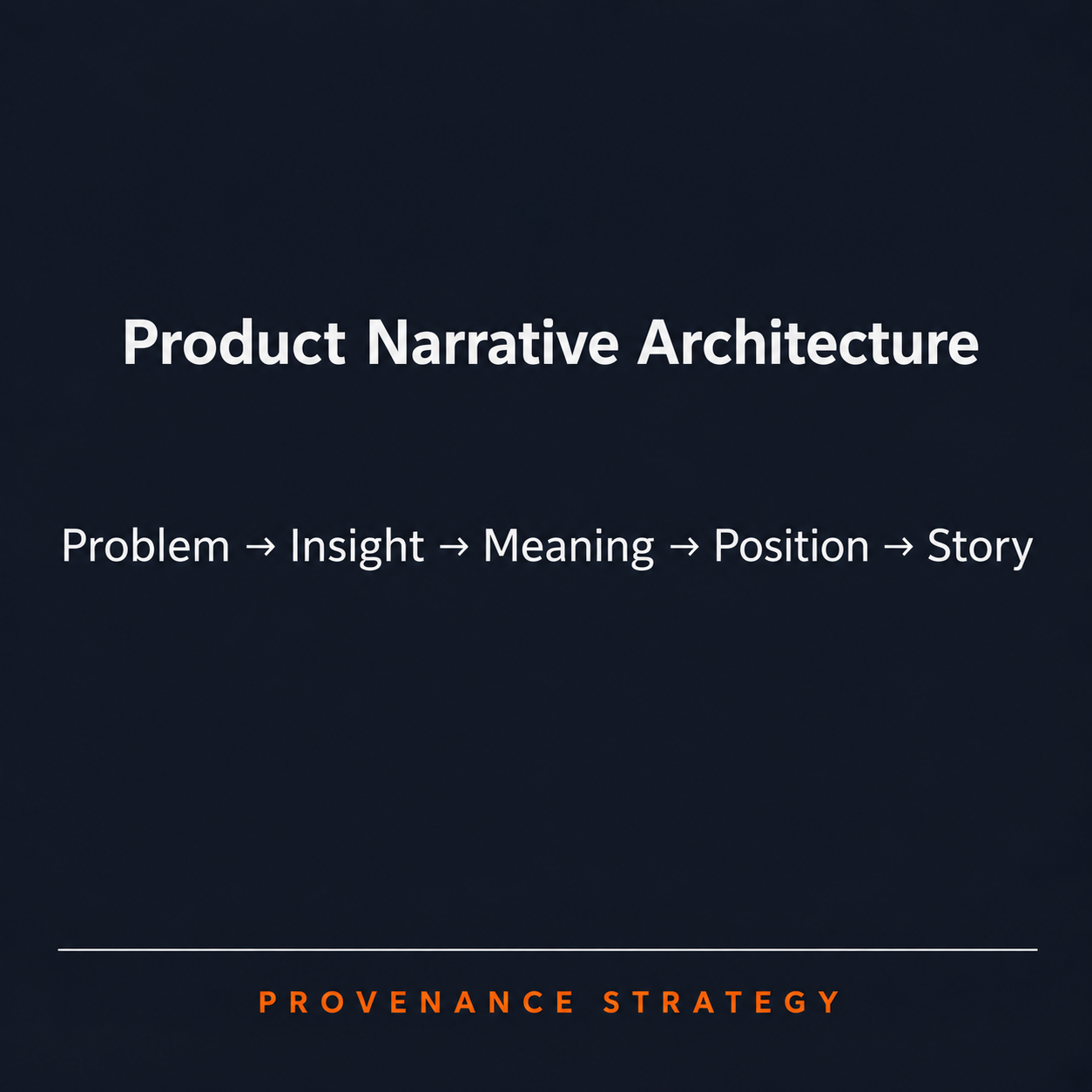
I think of this as Product Narrative Architecture.
Problem → Insight → Meaning → Position → Story
Each layer builds on the one before it.
Problem
What tension or unmet need exists?
Insight
What understanding changes the way the problem is viewed?
Meaning
What broader interpretation emerges from that insight?
Position
How should the product be understood in the market?
Story
How is that meaning communicated and reinforced?
When these layers reinforce one another, products feel coherent.
When they separate, positioning becomes more difficult, messaging loses clarity, and differentiation becomes harder to sustain.
Products Often Begin at the Wrong Layer
Many organizations begin with the product.
Features are developed. Capabilities expand. Positioning arrives near the end of the process.
The assumption is that interpretation can be clarified later.
By then, the product has already begun communicating. Every design decision signals priorities, intended users, and strategic tradeoffs. Before a marketing campaign appears, customers are already forming impressions about what the product represents.
This is why communication cannot resolve every positioning challenge.
Messaging can sharpen an idea that already exists, but it cannot create coherence where it was not intentionally designed.
Meaning Is Shaped Through Strategic Emphasis
Products communicate through the choices organizations make.
Which customer matters most.
Which problem receives the greatest attention.
Which capabilities define the product.
Which tradeoffs are accepted.
Those decisions accumulate into a narrative architecture that shapes how the market understands the product.
This process does not require intention. Every product develops a narrative. The difference is whether that narrative emerges by design or by default.
That is why some products feel immediately understandable while others require constant explanation.
One communicates a coherent interpretation. The other communicates competing ones.
Why Positioning Weakens
Positioning weakens because the product begins carrying too many interpretations at once. Not weaken because teams forget how to communicate.
As products evolve, features expand, audiences broaden, use cases multiply, and new messaging layers accumulate. Individually, these decisions make sense. Collectively, they can blur what the product is meant to represent.
The response is typically the same.
Teams revisit the messaging.
They refine the positioning.
They search for clearer differentiation.
Those efforts improve communication.
When interpretation becomes fragmented, the challenge is no longer one of communication, but of architecture.
Meaning Must Be Architectural
Products become meaningful when every layer reinforces the same underlying interpretation.
That alignment begins with the problem being solved. It continues through the insight, the product decisions, the positioning, and the story the organization ultimately tells.
When those layers reinforce one another, products become easier to understand, easier to remember, and easier to differentiate.
Narrative does not begin at launch, but through the decisions that shape the product from the beginning.
Why This Matters
Functional advantages have become easier to replicate.
Comparable capabilities are easier than ever to build. New features spread quickly, competitors respond faster, and technical differentiation becomes more difficult to sustain.
Clarity is the challenge.
The products that stand out are those where product decisions, positioning, and narrative reinforce the same underlying interpretation.
That consistency creates recognition.
More importantly, it creates understanding.
Products that are easily understood are easier to position, easier to differentiate, and more durable.
Closing Thoughts
Products do not become meaningful through messaging.
They become meaningful through the decisions that shape them.
Every choice—from the problem being solved to the tradeoffs accepted—shapes how the market interprets the product. That interpretation is difficult to change after launch.
This is why Product Narrative Architecture belongs at the beginning of product strategy rather than the end of marketing.
Organizations that understand this build products the market understands from the very beginning.