

What Strategic Question Does the Product Answer?
Products gain clarity when they answer the right strategic question. Execution becomes the focus of every product development effort. Features are refined, roadmaps become more detailed, positioning discussions begin, and launch planning takes shape.
One question is often not addressed:
What strategic question is this product actually answering?
Most organizations begin with practical questions.
What category are we entering?
What features should we include?
What audience are we targeting?
These questions are useful but do not go far enough.
Stronger questions reach beyond the product.
What market shift does this product respond to?
What tension does it help customers navigate?
What changing behavior makes it increasingly relevant?
Why does this need to exist now?
When those questions remain unanswered, products struggle to maintain coherence. When the strategic foundation is not established, execution becomes irrelevant.
Most Products Begin With Solutions
Many product development efforts begin with a solution already in mind. A new capability. A technology. A feature set. An operational improvement. From there, the process is as follows: Teams build, refine, position, and prepare for launch.
Organizations are designed to solve problems. Once a promising solution emerges, attention naturally shifts toward execution. Development accelerates, decisions accumulate, and the product begins taking shape.
The strongest products are more than well executed. They are guided by a strategic question before development gains momentum.
Strategic Questions Create Direction
Strong products begin with a clear understanding of the change they are responding to. This is what understanding the market comes down to.
Organizations need to move faster without losing coordination. It may be behavioral. Consumers are trying to simplify fragmented decisions. Or it may be structural. Technology lowers barriers to entry, expertise becomes more distributed, and organizations adapt to new forms of competition.
A strategic question gives product development direction before decisions accumulate. It establishes a shared understanding of why the product exists and the role it should play as the market evolves.
With this direction in place, product decisions become easier to make. Positioning builds. Messaging reflects a strategy. The product develops around a common purpose rather than a collection of independent decisions.
Without that direction, organizations experience the opposite. Positioning begins to shift, features expand without reinforcing a common purpose, and messaging changes as teams try to explain decisions that were never anchored to a shared strategic question.
Customers recognize those inconsistencies even if they cannot describe them. The product may be technically capable, yet still feel difficult to understand. Differentiation becomes harder because the market struggles to recognize what the product uniquely contributes.
Products should help customers navigate change versus compete on features.
Story-First Product Development
Story-First Product Development begins by asking how the product should be positioned after development is complete. It asks what strategic question the product should answer before development begins. This question becomes the reference point for every product decision that follows.
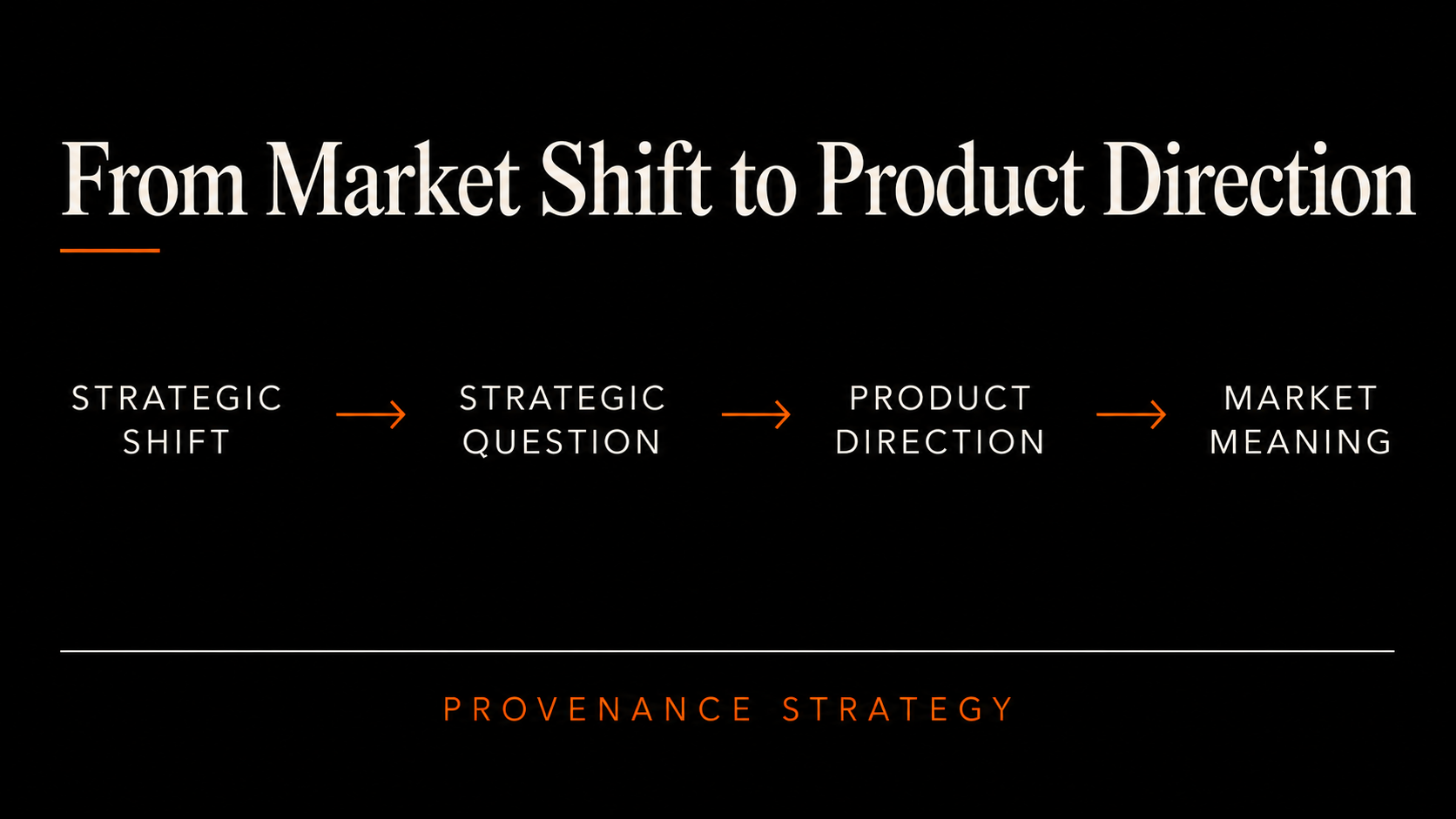
The framework moves strategic thinking upstream. Organizations establish a shared understanding of the change the product will address before development accelerates. Product decisions reinforce the direction. Narrative grows from these decisions, and launch introduces a story that emerges from the process.
The story customers encounter reflects decisions aligned around a shared strategic direction from the beginning. Not a story assembled at the end of development.
Closing Thoughts
Products do not exist independently from the environments around them. Markets evolve. Customer behaviors change. New technologies emerge. Every meaningful product is, in some way, a response to those changes.
The strongest organizations recognize these changes before development accelerates. Products gain strategic clarity when organizations understand the shift taking place in the market, then translate that understanding into the strategic question that guides product development from the beginning.