

NARRATIVE, INNOVATION, AND CATEGORY CREation
Markets cannot Not Organize Around they do not understand
Meaningful innovations often create uncertainty. The technology may be impressive, but that is typically not the market's biggest challenge.
Customers don't immediately know how to evaluate the innovation. Competitors aren't sure which capabilities are critical. Investors question the size of the opportunity. Even the language used to describe the innovation is still taking shape.
Before a market can organize around something new, it needs to understand what the innovation represents.
Therefore, innovation creates possibility but is not sufficient to create categories.
Categories emerge when markets start interpreting an innovation in similar ways. Customers develop expectations. Investors see a definable opportunity. Competitors respond to a similar set of assumptions. Eventually, the market develops a shared understanding of what the innovation is, its importance, and where it fits.
Narrative plays an important role in achieving market understanding.
Narrative gives markets a way to understand change. It provides language and mental models for something that was previously unfamiliar.
As that understanding spreads, uncertainty fades.
Innovation Creates Possibility, Not Categories
History is full of impressive innovations that never became enduring categories. New technologies arrive with significant investment, genuine technical breakthroughs, and early enthusiasm. Many go nowhere.
Sometimes the technology isn't good enough. Sometimes there isn't enough demand. There is another problem that receives less attention. The market fails to develop a clear understanding of why the innovation is important or how it fits with customers.
Early in category formation, the same innovation can be described in completely different ways. Companies emphasize different problems, capabilities, and visions of the future. Customers aren't sure what they should value. Investors aren't sure what opportunity they are evaluating. Competitors aren't sure what they are competing against.
Over time, some interpretations gain traction and others disappear.
A common language takes form. Expectations become clearer. Customers know what they are evaluating. Competitors know what they are competing against. Investors can see the boundaries of an opportunity that previously looked ambiguous.
The innovation may not have changed very much. Yet the market’s understanding has changed.
Narrative Creates Shared Interpretation
When something genuinely new enters a market, people ask pretty basic questions.
What is this? How is it different? Why should I care? Where does it fit into my life or business?
Narrative helps answer these questions.
Consider the emergence of software delivered through the internet. The technical capability existed before most customers had a clear way of thinking about what it represented.
See Salesforce. Enterprise software did not require installation, maintenance, ore periodic upgrades on company's servers. It could be accessed through the internet as an ongoing service.
That was more than a different way to deliver software. It gave the market a different way to think about software.
As that interpretation spread, customers developed new expectations. Competitors adapted. Investors recognized a different business model. Eventually, software as a service became familiar enough that SaaS doesn’t require explanation today.
While the technology was important, so to was the market's ability to understand what the technology represented.
This is why narrative should be viewed as a coordination mechanism.
Markets do not necessarily need everyone to agree. They do need enough shared understanding for customers, competitors, investors, and others to organize around similar expectations.
This is how a new and unfamiliar innovation becomes a category.
Categories Emerge Through Shared meaning
An established category was once likely to have been unfamiliar in the market.
There was a time when people didn't know how to think about ride-sharing, cloud software, energy drinks, electric vehicles, or Generative AI.
The innovations arrived before the understanding.
Consider Generative AI. The underlying technologies advanced for years. Yet, for most people, Generative AI remained abstract. They understood the term, but they didn't necessarily have a clear mental model for what it could mean for their own work or lives.
Then millions of people started using the technology.
Suddenly, the market had something concrete to organize around. Prompts, copilots, AI assistants, large language models, and generated content became part of the vocabulary. Organizations began asking similar questions about productivity and automation. Investors could see a more recognizable market opportunity. Competitors built and positioned products around these expectations. Generative AI became more than an abstract technological capability.
Once people can describe something in similar ways, they can develop widespread expectations that allows a category starts to take shape.
The Strategic Opportunity
Organizations often think they are competing to build the best product.
In emerging markets, they are also competing to shape how the market understands the problem.
Early categories are unsettled as the market is trying to make sense of what it is seeing.
Organizations have an opportunity to participate in that process. They cannot control how a market evolves. Narrative also cannot manufacture a category when there is no meaningful innovation or customer need.
Organizations can however help establish the language and expectations through which an innovation is understood.
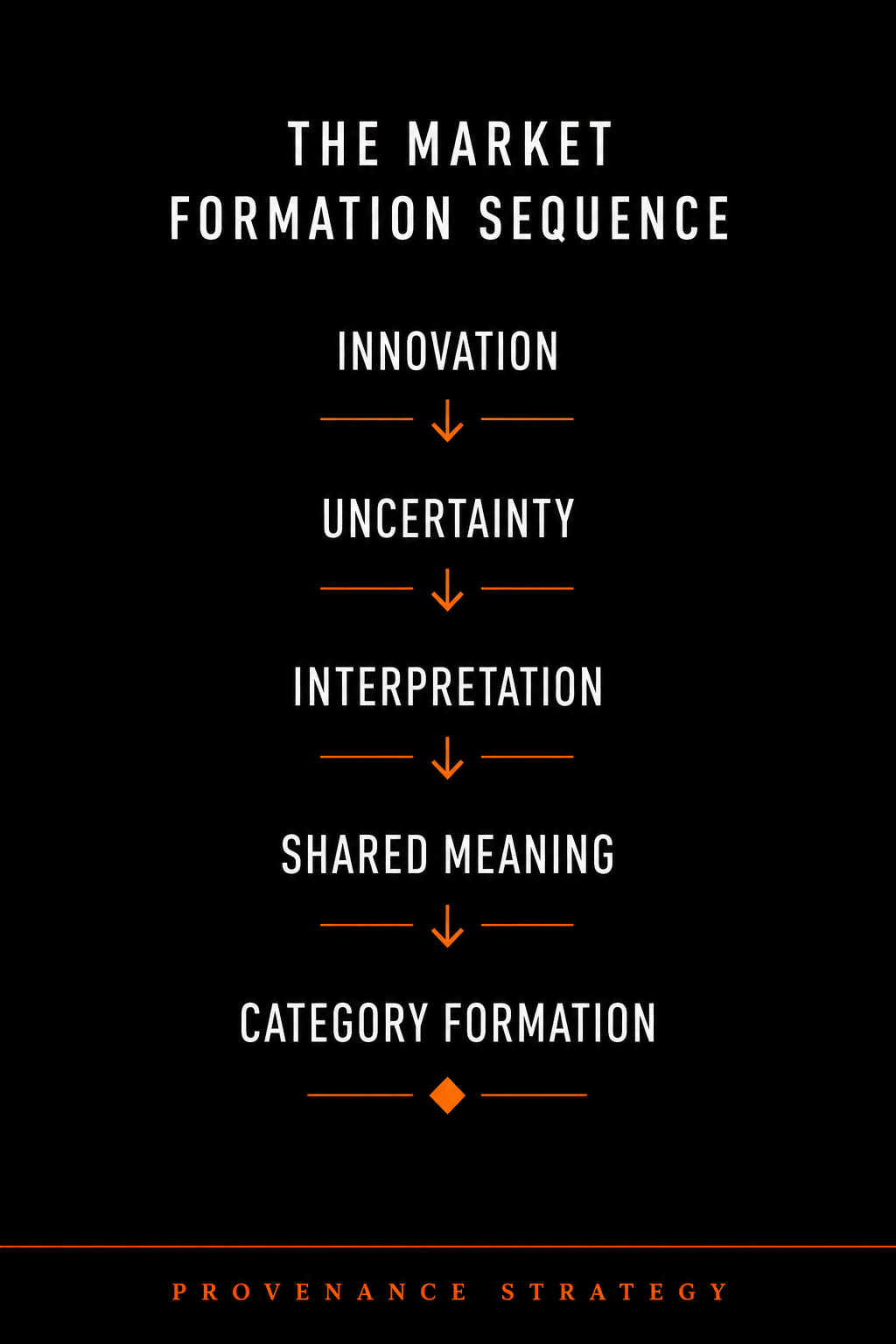
Think about the following progression:
Innovation → Uncertainty → Narrative → Shared Interpretation → Category Formation → Market Organization
This is an important strategic opportunity.
An organization that helps the market understand what has changed is likely to influence what customers value, which capabilities become important, how competitors position themselves, and even the language used to describe the category.
The organization helped the market understand the category even if it doesn’t necessarily own the category.
Closing Thoughts
Categories start with uncertainty.
An innovation appears, but the market doesn't immediately know what to make of it.
Over time, interpretations converge. Common language develops. Expectations become clearer. Customers understand what they are evaluating. Competitors understand what they are competing against. Investors begin to recognize a definable opportunity.
The market organizes.
Innovation creates possibility.
Shared interpretation creates categories.
Narrative helps markets get from one to the other.